All Roads of Imagination: Inside Jean-Charles de Castelbajac’s Pop Culture Universe
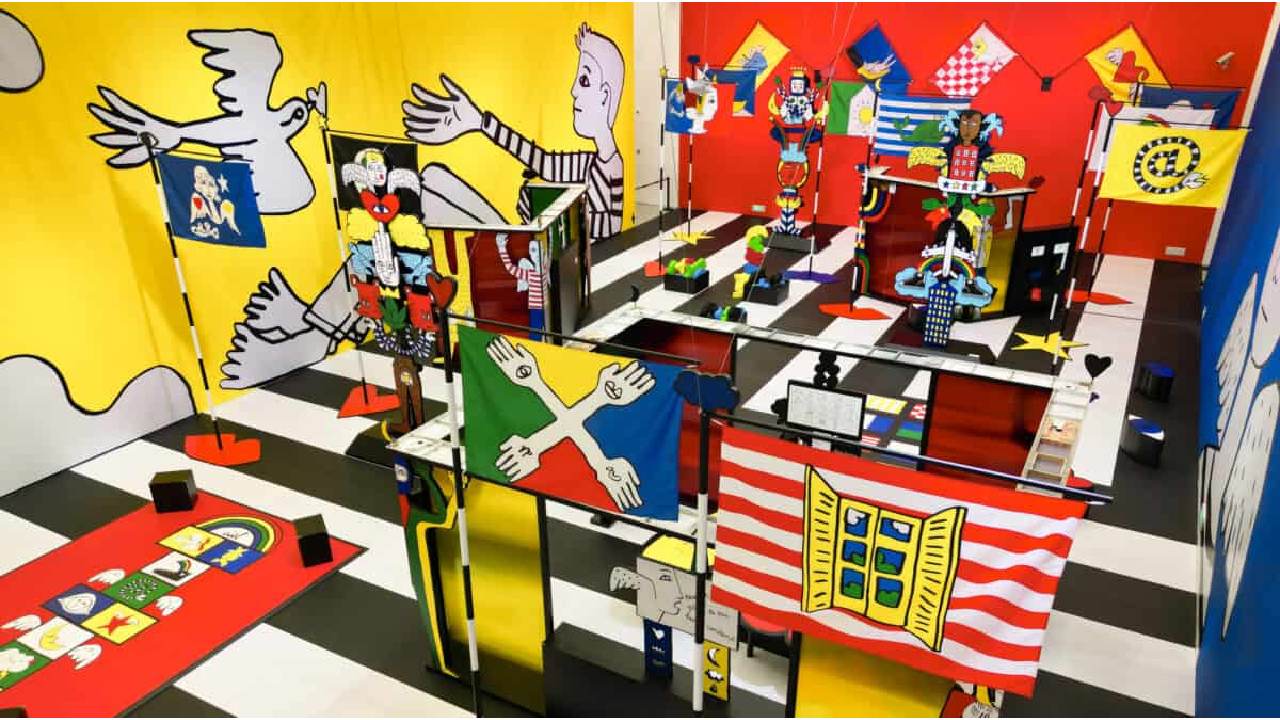
PetitePaulina – Few fashion designers embody the idea of “six degrees of separation” quite like Jean-Charles de Castelbajac. Over nearly six decades, his creative path has intersected with artists, musicians, photographers, and cultural icons across generations. From Andy Warhol and Keith Haring to Lady Gaga and Beyoncé, his work feels omnipresent, quietly woven into pop culture’s visual memory. This interconnected legacy is the heart of “Jean-Charles de Castelbajac, the Power of Imagination,” a major exhibition that recently opened at Les Abattoirs in Toulouse. The show invites visitors to trace how one designer’s curiosity led him everywhere at once. Transitions between fashion, art, religion, and politics feel natural in his world. Castelbajac’s career reads less like a linear timeline and more like a constellation, where ideas, people, and moments continuously collide and spark new meaning.
Les Abattoirs and a Museum’s Bold New Direction
For Les Abattoirs, hosting this exhibition marks a turning point. Known primarily as a contemporary art museum, it is presenting fashion for the first time. Director Loriane Gricourt explains that the goal is to reposition Castelbajac’s work within a broader cultural context. By doing so, the museum challenges the idea that fashion exists separately from art. Nearly 300 objects fill the space, ranging from iconic garments to photographs, films, collages, and archival documents. This curatorial approach allows visitors to see fashion not as isolated pieces, but as part of a living dialogue with society. The exhibition’s scale and ambition reflect Castelbajac’s influence, while also signaling the museum’s openness to new narratives. It is a meeting point where disciplines overlap, echoing the designer’s lifelong refusal to stay in a single lane.
“Read More : Berlin’s Achtung Magazine Turns the Page Toward Fashion Film”
Beyond Icons: Revealing a Multifaceted Body of Work
Jean-Charles de Castelbajac is often reduced to a few iconic images: the teddy bear coat, bold primary colors, cartoon sweaters. While these pieces are undeniably powerful, they represent only a fragment of his story. The exhibition works deliberately against this simplification. It reveals a designer whose work constantly evolved, absorbing new references and responding to cultural shifts. Gricourt emphasizes that Castelbajac’s vision was pioneering, even when it went unrecognized. He blended high and low culture long before it became fashionable to do so. His clothes spoke to pop stars and priests alike, reaching audiences far beyond traditional fashion circles. This broader perspective reframes Castelbajac not just as a designer of objects, but as a builder of meaning, using clothing as a language to reflect, provoke, and connect.
A Rebel Who Belonged to the Establishment
Emerging in the 1970s alongside Jean Paul Gaultier, Thierry Mugler, and Kenzo Takada, Castelbajac helped redefine French fashion through ready-to-wear. Yet he always stood slightly apart. He embraced rebellion while remaining deeply engaged with institutions. His friendships ranged from punk musicians like the Sex Pistols to artists such as Jean-Michel Basquiat, while his work eventually reached the Vatican. This duality defines his uniqueness. He questioned norms without rejecting tradition entirely. The exhibition captures this tension through contrasting elements: medieval heraldry alongside street culture, sacred symbols beside pop graphics. Castelbajac’s career proves that disruption does not require exclusion. Instead, he infiltrated systems with color, humor, and symbolism, reshaping them from within. That balance between outsider energy and insider influence remains central to his enduring relevance.
Sustainability and Art-Fashion Crossovers Before Their Time
Long before sustainability became a fashion imperative, Castelbajac experimented with upcycling. In the late 1960s, he created garments from mops, blankets, and medical bandages, decades ahead of mainstream adoption. The exhibition highlights this foresight, linking it to his later role as artistic director at Benetton, where he continued pushing sustainable ideas. Equally influential was his role in merging fashion and art. Invitations designed by Keith Haring, photographs by Robert Mapplethorpe, and hand-painted dresses all demonstrate how naturally he collaborated across disciplines. He also pioneered the idea of featuring fellow designers in advertising campaigns, turning peers into protagonists. These gestures blurred boundaries and set templates that others later followed. Castelbajac didn’t wait for trends; he built them quietly, through instinct and experimentation.
“Read More : Chase Infiniti Embarks on a New Chapter as Louis Vuitton’s Latest Ambassador”
Clothing as a Political and Cultural Statement
Castelbajac’s work has never shied away from controversy. One of the exhibition’s most striking stories involves a yellow sequined dress bearing Barack Obama’s portrait, worn by Katy Perry in 2008. While it received a standing ovation on the runway, it also sparked threats that revealed fashion’s political power. That moment, Castelbajac admits, changed his understanding of clothing’s impact. His designs often carried messages, whether through cartoons, slogans, or symbols. Even his clerical outfits for the reopening of Notre-Dame de Paris became subjects of heated debate worldwide. For him, reaction positive or negative is part of the creative process. Clothing, in his view, is not neutral. It speaks, challenges, and sometimes unsettles. That willingness to engage with consequence keeps his work alive in public discourse.
Transmission, Not Legacy, as the Final Message
The exhibition’s final section focuses on what comes next, rather than what has already been achieved. A vibrant mural of breakdancers dominates the space, signaling movement, youth, and continuity. Castelbajac describes the exhibition as an act of transmission, not self-celebration. He invites younger generations to adopt his methods, his approach to appropriation, and his habit of subversion. The goal is not imitation, but reinvention. By opening his universe so fully, he encourages others to build their own. This generosity may explain his longevity. Castelbajac understands that creativity lives through sharing and staging ideas for the world. In that sense, all roads do seem to lead back to him not as an endpoint, but as a crossroads where imagination keeps moving forward.